
Champaign VINELink Release Coverage
Tri-County Regional Jail publishes local instructions for VINE, a free and anonymous automated service. Its official page says the network covers custody information from Ohio DRC, the Department of Youth Services, and county jails. It lists release, transfer, escape, return after escape or re-arrest, and death among the transmitted custody changes. The same page expressly excludes city-jail facilities. That limit matters because a statewide logo does not prove that every local lockup supplies data.
The Ohio VINELink portal can be used for a named Tri-County or participating ODRC record. It should not be treated as a broad list of all people released in Champaign County. A local court defendant may never enter a covered facility, and a person may transfer between systems. Federal BOP, ICE, and USMS matters use their own channels. The originating jail or DRC record remains the best source for the exact event.
| Custody system | VINE role | Confirmation source |
|---|---|---|
| Tri-County Regional Jail | Participating county-jail custody events | Tri-County release or transfer sheet |
| Ohio DRC | State custody and offered notice events | DRC offender detail and Central Records |
| City jail | Excluded by Tri-County's local coverage statement | The city agency that held the person |
| Federal or immigration custody | Not covered by this Ohio VINE path | BOP locator, ICE locator, federal docket, or agency record |
Search Champaign VINELink by Person
Identity comes first. Names can repeat, spellings can vary, and an old result may concern another custody event. Compare the name with an inmate or offender ID, the reporting agency, facility, and other identifiers lawfully displayed. A photograph can help separate similar names, but a photo does not prove release. When an Ohio prison case is involved, compare the DRC number and county or docket facts with the separate DRC detail.
- Open Ohio VINELink and choose the custody or offender search shown by the current interface.
- Enter the person's name. Add an ID when known, but use fewer criteria if an exact search returns no match.
- Compare every candidate's agency, facility, identifier, and identity fields. Do not choose on name alone.
- Open the matching record and read the current status or event without changing its label.
- If the person remains in covered custody, select Register or Get Notifications and review the events offered.
- Record the alert wording and time. Confirm a release, transfer destination, or discharge with the source agency.
A no-result has several possible causes. The person may be outside VINE coverage, newly admitted, recorded under another spelling, moved to another agency, or affected by feed timing. Search the receiving facility when a transfer is known. If the last custodian was Tri-County, call the jail and request the existing release or transfer entry. A missing result is not affirmative proof of community release.
Champaign VINELink Release Fields
VINELink is an event and notice system, not a complete court or jail file. The current interface controls which fields appear. A useful result identifies the person, the participating agency or facility, and the custody status or event that agency transmitted. Some records offer an identifier and registration controls. Do not add a scheduled or actual date unless it is visible in the live record and clearly labeled.
| Field | What it supports |
|---|---|
| Name and identifier | Helps distinguish the intended person from a similar name |
| Agency or facility | Shows which participating source sent the custody data |
| Custody status or event | Reports the source's current label, such as release or transfer |
| Event time, when offered | Shows transmission or recorded-event context, not always physical-processing time |
| Notification controls | Shows which events and contact channels can be registered now |
A transfer must stay labeled as a transfer. It can lead to another county jail, WCCCF, ODRC, USMS, ICE, or another custodian. A release alert likewise does not explain the court outcome or whether supervision begins. Compare the alert with the jail sheet, court order, or DRC release detail. For a broader named-person record path, the Champaign County released-inmate lookup explains how the local, state, and court channels fit together.
The Ohio VINE search screen shows the official starting point used for a specific-person query.
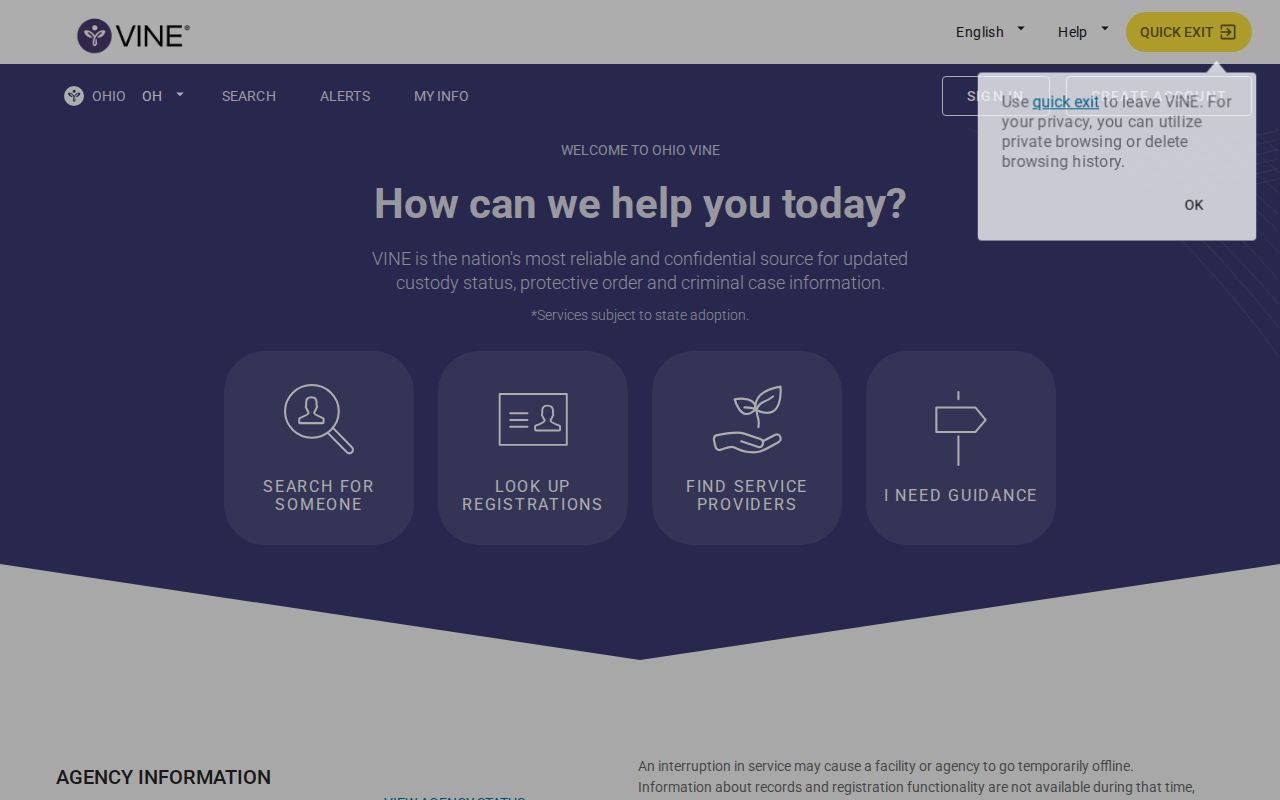
The screen is a gateway to live agency data. The matching result and event label, not the landing page alone, supply the fact that must be verified.
Tri-County VINE Phone Registration
Tri-County's local instructions add details that a general VINELink description can miss. A caller may use 800-770-0192 and should have the inmate's name or identification number ready. Each telephone number must be registered separately. The caller selects a four-digit PIN, which is later used to acknowledge the automated notice. That PIN is private and is not the inmate ID.
The local page says the system may leave a message on an answering machine. Calls continue for 24 hours or until the recipient enters the PIN. English and Spanish notification are described, along with translation by phone. Anyone may register. These points support the phone workflow for Tri-County, but contact choices displayed online should be described only as the live interface offers them.
The Tri-County victim-notification instructions document the event list, phone alternative, PIN, and repeat-call loop.
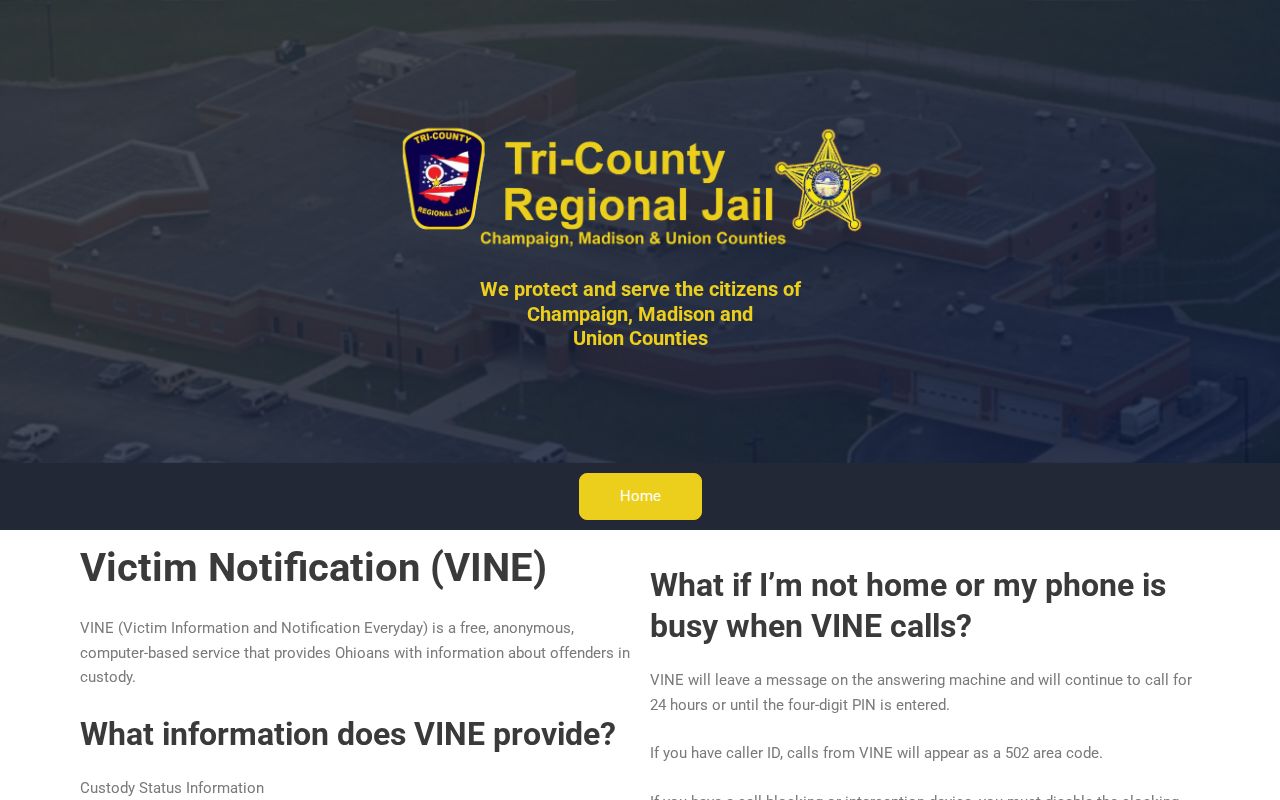
The local instructions are especially useful when web registration is unavailable, but they still lead back to the jail for the underlying release or transfer record.
Note: Register each phone separately and keep its four-digit acknowledgment PIN private so repeated calls can be stopped safely.
Register Champaign Release Notifications
Register while the correct custody record is active. Open the matched record, select Register or Get Notifications, and choose only the events and contact methods offered on screen. Depending on the current interface, those methods may include phone, email, or text. Complete any verification step. For phone registration tied to the Tri-County instructions, select the four-digit PIN and retain it securely.
- Confirm that the name, ID, facility, and agency all match the intended person.
- Select the offered release or custody-change events relevant to the notice needed.
- Add one contact channel at a time and complete the verification shown by VINELink.
- For each registered phone number, create the private four-digit PIN described by Tri-County.
- When an automated call arrives, enter the PIN to acknowledge it and stop the repeat-call loop.
- Call the source agency when the exact disposition, destination, or physical release time matters.
An alert can arrive after the legal order or physical movement because systems record different stages. A court entry proves an order. The jail sheet records physical processing. VINE reports the event supplied through its feed. Preserve each label and time instead of forcing them into one timestamp.
Confirm Champaign VINELink Release Alerts
VINE can lag and does not certify a release sheet. For a local event, call Tri-County at 937-834-5000 and request the person's booking and release entry, including date and time, disposition, authority, and transfer destination when applicable. Check Municipal Court or Common Pleas for the order behind the movement. If the court shows an ODRC commitment, use the DRC search rather than calling the transfer a return to the community.
For a state-prison event, read the DRC header status together with Parole or Release Information and the supervision block. “APA Supervision” means the person is outside ordinary prison confinement but still under state control. For a federal sentence, use the BOP locator and federal docket. An immigration movement requires the ICE locator and source records. None of those systems can be replaced by a Tri-County VINE no-result.
Dates from different sources answer different questions. A court journal entry records an order. A VINE time reflects the event supplied through the participating feed. A completed release sheet records the jail's physical processing. If those times differ, keep each source label and ask the custodian to resolve the sequence. Do not present the first alert as the exact moment a person reached the community.
The destination also needs proof. “Released to other agency” describes a handoff, not freedom from custody. Ask which agency received the person, then follow the record into ODRC, another county, WCCCF, USMS, or ICE as supported. When the source will not disclose a destination, a commitment order, transport entry, federal docket, or receiving locator may supply the missing context. The narrow wording “VINE reported a transfer” is more accurate than an unsupported release claim.
Registry alerts also remain separate. Ohio's sex-offender registry applies only to its statutory population and does not provide a general release history. A registry listing or photo does not establish when the person left jail. The narrow result is the sound one: VINE reported a named custody event, then the participating agency confirmed its type and destination.
Note: A VINE alert supports prompt notice, while the originating jail, DRC, or court record supplies the lasting documentary proof.