
No Champaign 72-Hour Release Feed
Neither Champaign County nor Tri-County Regional Jail published an official three-day release archive in the sources reviewed. The available Tri-County portal is expressly limited to people currently in custody. It provides a name or alphabet search, a security check, the TRI-JAIL identifier, phone, current population, last update, and a 30-minute information-update interval. Those details describe a live roster.
The 30-minute cadence says nothing about released-record retention. It does not create a rolling 72-hour window. No official interface exposed a release-date filter, recent-departure tab, or past-inmate archive. Periodic snapshots would also fail because a name that disappears between snapshots could have transferred, and brief admissions or departures could be missed. A direct request for existing release entries is the sounder source.
Build a Champaign Three-Day Request
A 72-hour inquiry should identify the complete date range, exact start and end times, and local time zone. Ask Tri-County for the existing release log or release entries for that span. Requested fields can include booking number, physical release date and time, release disposition, releasing authority, bond notation, and transfer destination where publicly available. This asks for maintained records rather than requiring staff to compile a new analysis.
- Set an exact three-day interval, including times and time zone.
- Call Tri-County at 937-834-5000 to confirm which office keeps the release entries.
- Send a focused request for the existing log or named booking sheets within that span.
- Compare each event with Ohio VINE and the correct Champaign court docket.
- Follow any transfer to ODRC, another jail, WCCCF, USMS, or ICE in the receiving system.
If the jail indexes records by person or booking number rather than release date, narrow the request. Ohio's Public Records Act addresses public-record access and permits the office to help revise an ambiguous or overly broad request. No special release-log fee or promised response period was found. Ask about format and cost before ordering copies.
The Released Last 24 Hours page offers a tighter method when only the current day matters.
Champaign 72-Hour Release Fields
These fields belong in a records request because the current roster does not display a three-day release list. Read them as a set. One field alone rarely explains whether custody ended or merely changed hands.
| Requested field | Why it matters |
|---|---|
| Name and booking identifier | Separates similar names and connects the correct jail event. |
| Admission date and time | Identifies the booking tied to the departure. |
| Physical release date and time | Places the completed jail movement inside the three-day range. |
| Disposition or release type | May identify bond, dismissal, sentence completion, transfer, or another event. |
| Releasing authority | Points to the court or agency record supporting the move. |
| Transfer destination | Shows when the person remained in custody elsewhere. |
| Bond notation and charges | Adds case context but does not establish the final disposition. |
A court journal entry may authorize release before Tri-County finishes the physical process. It may also show an ODRC commitment, WCCCF placement, community control, or electronic monitoring. Municipal Court is relevant to misdemeanors, traffic matters, and early felony stages. Common Pleas controls adult felony dispositions. When a felony moves between courts, inspect both dockets.
Champaign Weekend Release Verification
The wider interval is most useful as a catch-up tool. A person checking on Monday may need entries from Friday through Monday rather than one calendar date. Keep the boundaries exact. “Over the weekend” can be unclear, while start and end timestamps let the custodian locate a defined set of records.
Weekends and holidays do not change the evidence hierarchy. A court order can precede identity checks, holds review, property return, and the completed release timestamp. Another agency may accept custody during the span. VINE transmission may also occur at a different time from the court order or jail release sheet. Preserve each source label instead of forcing the times to match.
For one named person, begin with the last known custodian rather than searching every system. The Champaign County released-inmate guide maps local jail, state prison, federal, and immigration routes.
Champaign Roster Removal Is Ambiguous
The current Tri-County roster visually documents its present-custody scope and update cadence.
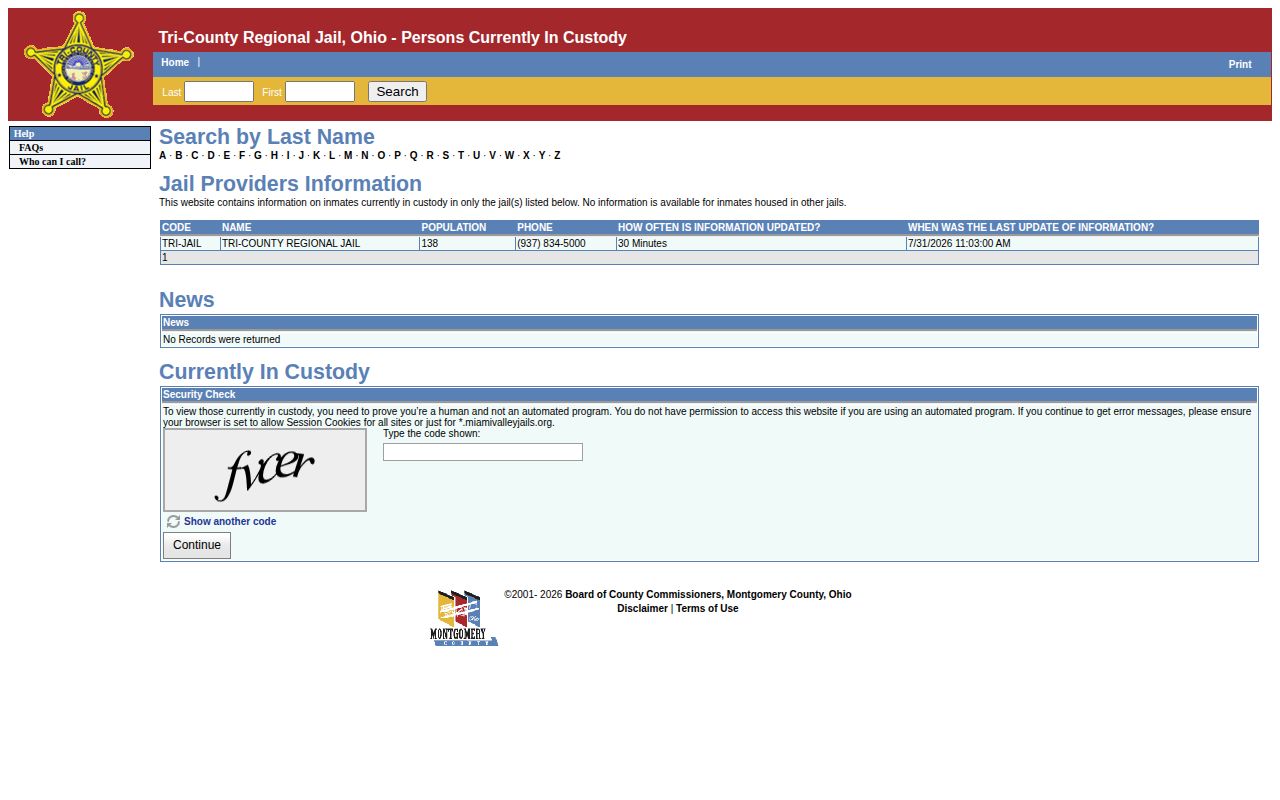
A person present in the results is listed in that jail's current feed at the displayed update time. A person absent may have returned to the community, transferred, appeared under another name, or fallen outside a delayed feed. Save the access time and spelling used. Then seek a jail event record or a VINE event. Current population is not a release count because it blends admissions and departures.
Corroborate Champaign Multi-Day Events
Tri-County's local VINE page describes a free custody-information service and lists release, transfer, escape, return after escape or re-arrest, and death among the reported changes. Search the named person, compare identifiers and facility, and read the exact event. A VINE alert supports event timing but is not a certified release sheet. Call the named custodian when the destination or disposition matters.
Court records supply legal authority and case outcome. A bond or dismissal entry may explain why release was authorized, but does not prove the minute physical processing ended. A commitment entry may show that the person left Tri-County for ODRC. WCCCF is a residential community-control placement, not a county-jail release archive or state prison. Electronic monitoring can also mean someone is outside the jail building while remaining under court control.
For state cases, DRC's search includes Incarcerated, Released, APA Supervision, and Violators at Large statuses. Read the detail and release or supervision fields together. A transfer into ODRC during the 72-hour span is continued custody. A later DRC release is a separate state event.
Classify Champaign Custody Destinations
A multi-day list can combine events that look alike but mean very different things. Bond and recognizance are pretrial departures and do not end the charge. Dismissal is a court disposition, though jail processing may finish later. Time served and sentence expiration concern completed custodial terms. Parole and post-release control move a state prisoner into supervised community status. Probation or community control is imposed by a court.
Transfers require special care. ODRC, another county jail, WCCCF, USMS, or ICE can become the next custodian. “Not on the roster” cannot distinguish among them. Ask for the destination and follow that system. BOP handles sentenced federal prisoners, while ICE's locator addresses immigration custody. A BOP or ICE result does not prove what happened in a Tri-County booking.
Note: “Released to another agency” is a custodial handoff, not proof that the person returned to the community.
Preserve Champaign Three-Day Evidence
The public roster's lack of released history does not mean the underlying jail record vanished. Live display and record retention are different questions. Save request dates, record the portal access time, and keep the custodian's field labels. If sources conflict, report each value with its source. Do not silently choose a court time over a jail time or a VINE time over both.
Historical court records often remain searchable after a name leaves the roster, subject to retention, sealing, expungement, and access rules. A missing result can arise from spelling, aliases, lag, the wrong system, or a sealed record. It proves no single outcome. The reliable three-day method is a defined interval, an affirmative event, legal authority, and a destination.
Public Record Search
Sponsored Results