
Champaign Projected and Actual Release
A projected date is forward-looking. It reflects the sentence and credits known to the agency at a given time. An actual release date records a completed event. Between them may come a recalculation, court order, disciplinary credit decision, parole action, detainer, or transfer. DRC therefore labels its public field “Expected Release Date/Parole Eligibility Date.” For a definite term it may function as a computed expected date. For an indeterminate or parole sentence it may mark eligibility for consideration, not a guaranteed prison exit.
Pretrial custody is different. A person awaiting a Champaign case generally has no fixed sentence-release date. Bond may be ordered, but the jail still must complete identity checks, holds review, property processing, and other lawful steps. A court entry proves authority, while the Tri-County release sheet proves the physical time. A person can also leave Tri-County for ODRC, another county, WCCCF, USMS, or ICE. That is a custodial transfer, not community release.
- PRD
- Projected Release Date, a computed future date used in a qualifying record.
- POA date
- Parole on or after, the earliest date for release on APA supervision in the applicable record.
- Parole eligibility
- A date when consideration may occur, not a grant of release.
- Detainer
- A notice or hold from another authority that may affect where the person goes next.
Find Champaign Inmate Release Dates
Choose the route by the last known custodian. Tri-County handles ordinary Champaign arrest custody. Ohio DRC handles a person committed to state prison. WCCCF is a residential community-control placement and should be verified with the Common Pleas docket and supervision office. A federal sentence uses the BOP locator and federal docket. Searching the wrong system can turn a transfer or no-result into a false release claim.
- Identify the case, sentencing court, and last known facility. Record the booking, case, or DRC number when known.
- For an Ohio prisoner, open the DRC Offender Search, search by name or number, and compare identity and Champaign commitment facts.
- Open the detail and read status, sentence class, jail-time credit, and the exact Expected Release Date/Parole Eligibility Date label together.
- For Tri-County, retrieve the sentencing entry, then ask the jail to confirm its current calculation and any existing release entry.
- For a pretrial case, check bond and holds through the court and jail. Do not invent a projected date.
- On or after an expected date, rerun the same record and look for a changed status and populated release information.
DRC searches can be narrowed by Released, APA Supervision, county of commitment, and other fields. If a search is too narrow, DRC advises using less criteria. Offender numbers use A, R, or W plus six digits without spaces or hyphens. Once the right detail is open, County of Commitment connects the record to the case origin, while Residential County is a recorded APA residence and does not establish live location.
A full search for a named person after the event is covered on the Champaign County released-inmate page. That route adds VINE, both local court levels, and documentary records when a live locator no longer answers the historical question.
Read Champaign DRC Release Fields
The DRC detail can contain admission date, institution, status, offense and sentence data, jail-time credit, county, docket, judge, aggregate sentence, the combined expected-date field, and supervision data. Read the header and sentence category before interpreting the date. DRC warns that the public detail may not show a complete sentencing list and that a supervision obligation can relate to a prior offense.
The official DRC expected-release example visibly separates the expected date from a later supervision start and term.
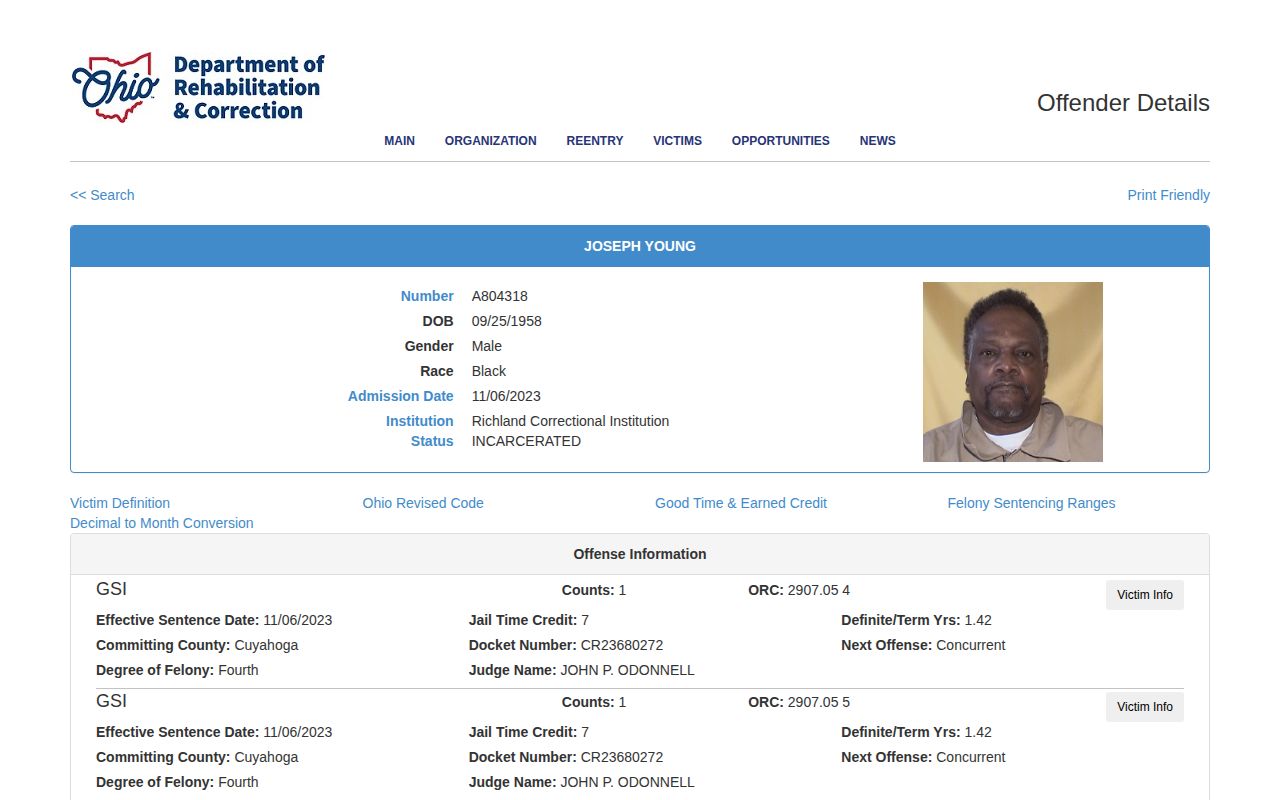
The example demonstrates the field structure only. It must not be treated as a standard sentence or a promise about another person. Prison exit and the end of APA supervision are distinct events.
| DRC field | How to read it |
|---|---|
| Status | Current DRC category, such as Incarcerated, Released, or APA Supervision |
| Expected Release Date/Parole Eligibility Date | A combined label whose meaning depends on the sentence class |
| Jail-time credit | Credited time that affects custody math under the applicable entry and law |
| Parole or Release Information | Populates with recorded release or parole detail when applicable |
| Supervision start and expiration | Shows a separate period of APA control after prison exit |
Note: Copy DRC's exact combined label and sentence context instead of shortening every value to a guaranteed release date.
Ohio Credits Shape Champaign Release Dates
Ohio Revised Code 2967.194 governs earned credit for qualifying confinement on or after April 4, 2024. Eligible people may provisionally earn one or five days for each completed month of productive participation, depending on the statutory category. A second qualifying activity can add up to five provisional days. DRC may deny or withdraw credit for violations, so the earned amount is not fixed merely because time passed.
For the ordinary monthly or program category, the aggregate ceiling is 15 percent of stated-term days. A separate completion-credit rule can provide 90 days or 10 percent, whichever is less, for each qualifying diploma, program, or criterion and operates notwithstanding the ordinary ceiling. Many terms are excluded, including mandatory or nonreducible terms and specified murder, life, and sex-offense categories. Historical confinement before the effective date remains subject to the transition framework in ORC 2967.193.
There is no safe rule that every Ohio prisoner serves 85 percent. That phrase is only rough arithmetic for some modern eligible definite terms under the ordinary ceiling. Mandatory portions may not reduce. Older regimes differ. Completion credit can work outside that ceiling. Jail-time credit changes the math, credits can be lost, and parole or indefinite terms follow different procedures. Use the live DRC calculation and current statute rather than applying a percentage to the imposed sentence.
ORC 2967.191 governs jail-time credit. The sentencing entry and DRC record should be compared when credited days appear wrong or incomplete. Do not recalculate a person's sentence from a web summary. Court entries, offense dates, sentence class, concurrent or consecutive terms, and administrative decisions can change the result.
Champaign Parole and Indefinite Dates
Parole eligibility is not release approval. ORC 2967.13 supplies category-specific timing for eligible sentences, including distinct life-sentence rules. DRC can search a Next Parole Board Hearing Date by YYYYMM, and the detail may show a hearing or review month. A hearing month does not reveal the decision. No verified standalone public results page was found, so a grant, denial, continuance, or rescission should never be assigned without the actual board or DRC record.
Ohio's Reagan Tokes framework also requires care. Under ORC 2967.271, qualifying non-life indefinite sentences carry a presumption tied to minimum-term expiration or a presumptive earned early release date. DRC may continue incarceration after the required hearing and findings. A displayed minimum or presumptive date is therefore not unconditional.
Transitional Control is another distinct status. DRC definitions describe movement up to 180 days before prison-term expiration or parole release into closely monitored community confinement, such as a halfway house or approved residence with electronic monitoring. It is not final discharge. Likewise, APA Supervision means ordinary prison confinement has ended but state supervision continues. Verify the office and supervision term from the live DRC detail.
Tri-County Credits Are Individual
Tri-County's inmate handbook provides a local rule that should not be replaced with the state-prison formula. It allows court-approved time off for eligible inmate workers and permits loss of earned good time for serious discipline. The handbook does not publish a formula that safely computes a named person's date. Use the sentencing entry and the jail's calculation.
A local sentence can also be affected by jail-time credit, another hold, a court modification, or a transfer. Ask Tri-County for the existing calculation or release record and identify the name, booking number, approximate period, and case. If an expected release is important, the question should be narrow: what date does the jail currently calculate, what court entry governs it, and are any known holds or destinations recorded?
Property and discharge processing can make the physical exit later than the legal order. The jail may review holds, complete identity checks, obtain a signed property inventory, and document the release or receiving agency. A projected date cannot supply those retrospective facts.
Note: Tri-County's handbook supports individualized credits and discipline loss, but it does not support a public one-size-fits-all calculation.
Why Champaign Release Dates Change
A change is not automatically an error. The calculation may respond to new court records, credit decisions, sentence-class rules, or another agency's lawful hold. When a date moves, preserve the old and new labels with access dates, then ask the custodian which record controls. Do not silently choose the value that seems most favorable.
| Factor | Possible effect | Record to check |
|---|---|---|
| Earned or completion credit | May advance an eligible expected date | DRC detail and current credit law |
| Denied or withdrawn credit | May move the expected date later | DRC calculation and authorized record |
| Jail-time credit correction | Changes credited custody days | Sentencing entry and DRC detail |
| Detainer or other hold | May change destination or prevent community release | Jail release sheet and receiving-agency record |
| Parole or indefinite-term action | Eligibility may not lead to release on that date | Board, DRC, and hearing record |
| Court modification or judicial release | Can alter the sentence or custody route | Common Pleas journal entry |
If an expected DRC date passes while the status stays Incarcerated, rerun the same offender number and contact DRC Central Records rather than declaring an overdue release. If status changes to APA Supervision, read the supervision start, expiration, and office. If the jail record says transferred, follow the person into the receiving system.
Confirm Champaign Actual Release Dates
For Tri-County, obtain the booking and release sheet or jail-register entry. Ask for admission and physical release date and time, release disposition, releasing authority, and transfer destination when public. Compare it with the Municipal or Common Pleas entry that supplied the legal authority. For state prison, rerun the DRC detail and look for a Released or APA status plus populated Parole or Release Information.
A pending notice can be registered through the Champaign VINELink release check. VINE is useful for prompt custody-change alerts, but the source agency must confirm the event. The court order, VINE transmission, and physical release can carry different times without contradiction because each records a different stage.
The sound final statement stays narrow: expected on a displayed date, eligible for parole consideration, physically released at a documented time, transferred to another custodian, or released from prison under APA supervision. Those terms answer different questions and protect the accuracy of a Champaign County inmate release-date finding.