
Ohio DRC Champaign Release Scope
Ohio DRC operates the state prison and Adult Parole Authority systems. No ODRC prison was identified inside Champaign County, but the statewide system becomes relevant when a Champaign felony sentence commits someone to state custody. Movement from Tri-County Regional Jail into ODRC is a transfer. It is not a community release. The Common Pleas commitment entry, Tri-County transfer disposition, and later DRC admission status document that custody chain.
A later state-prison record may show Released, APA Supervision, judicial release, Transitional Control, or another DRC status. Those labels must stay distinct. “APA Supervision” means the person has left ordinary prison confinement while remaining under state control. Transitional Control is closely monitored community confinement before the end of a prison term or parole release. Neither label means all legal obligations ended.
| Recorded event | What it establishes | What it does not establish |
|---|---|---|
| Tri-County to ODRC | Transfer into state custody | Return to the community |
| DRC Incarcerated | State-prison custody | County-jail location |
| DRC Released | A DRC release category with detail to inspect | End of every supervision term |
| APA Supervision | Outside ordinary prison confinement under APA control | Final discharge |
Confirm Ohio DRC Champaign Releases
The Ohio DRC Offender Search covers people currently incarcerated in an Ohio prison, currently under DRC supervision, or judicially released. It does not archive each local jail booking. A county-only bond, dismissal, time-served release, or short local term belongs in Tri-County and court records.
- Enter the last name first. Add a first name only when needed, because DRC advises using fewer criteria if a search is too narrow.
- Choose Champaign under County of Commitment when connecting the result to a state case committed from this county.
- Select Incarcerated, Released, APA Supervision, or Violators at Large according to the exact question.
- Compare name, DRC number, date of birth, photograph, conviction, county, and docket before choosing a result.
- Open the offender-number detail and read the header, sentence, expected date, release information, and supervision fields together.
- After an expected date, rerun the same DRC number and look for a changed status and populated release detail.
DRC numbers use A, R, or W plus six digits without hyphens or spaces. A five-digit women's number needs a leading zero. Other filters include ZIP, status, and next Parole Board hearing month in YYYYMM. Residential County is an APA residence field, not the commitment county or a verified present location.
Read Ohio DRC Release Details
An official detail may display admission, institution, status, offenses, sentence dates, jail credit, county, docket, judge, aggregate sentence, Expected Release Date/Parole Eligibility Date, release detail, and APA fields. DRC warns that the public record may not list every sentencing fact and that a supervision obligation can relate to a prior offense. Match the DRC number and docket instead of relying on the name or photograph alone.
The DRC field definitions show how release and parole labels are used.
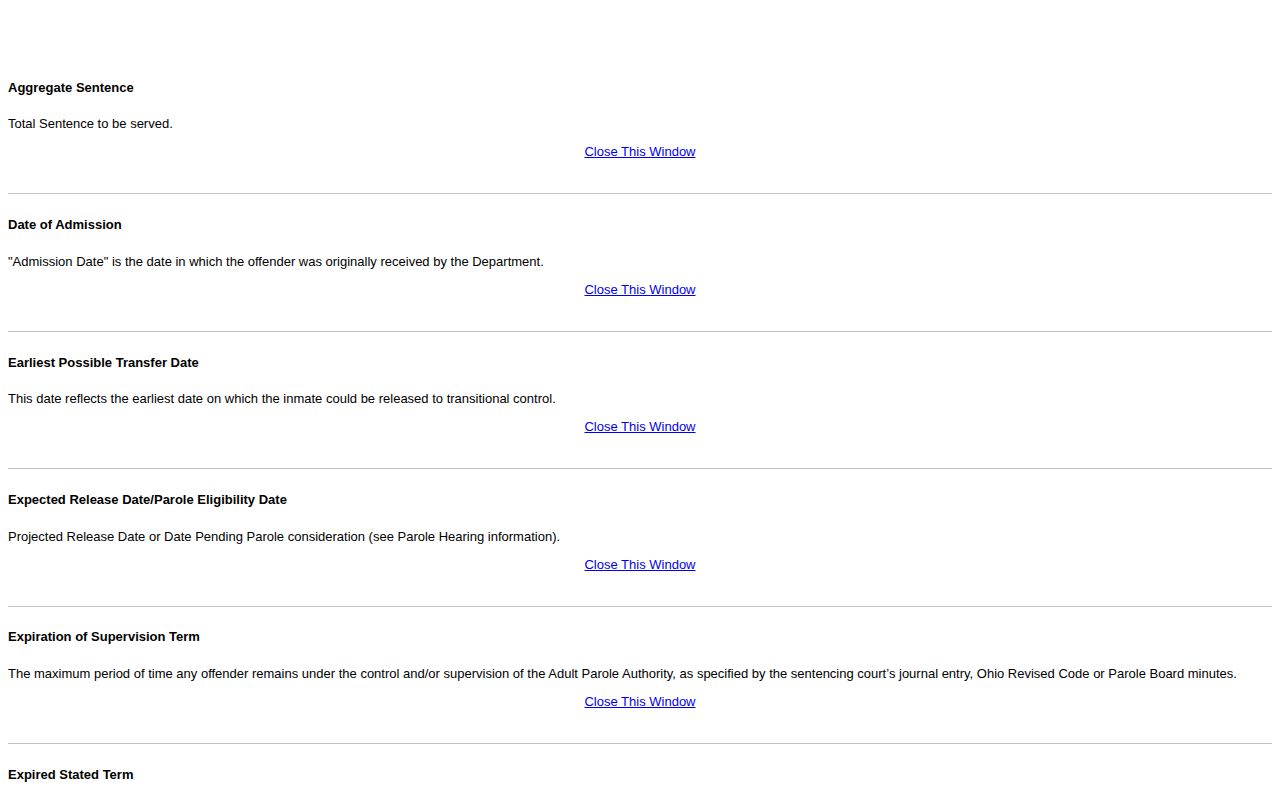
The definitions help interpret the interface, while the current statute controls when web wording is unclear. In particular, use current ORC 2967.191 for jail-time credit rather than repeating a malformed reference from a web definition.
- PRD
- Projected Release Date, a computed future date for an applicable sentence.
- POA date
- Parole on or after, the earliest release on APA supervision for the applicable record.
- Release detail
- DRC information that appears when an offender has been released or paroled.
- Supervision expiration
- The maximum date shown for APA control, separate from prison exit.
Ohio DRC Release Date Computation
The combined Expected Release Date/Parole Eligibility Date label is deliberate. A definite sentence may have a calculated expected release. An indeterminate or parole sentence may show eligibility for consideration. Parole hearings occur before the eligibility date so a decision can be made, but eligibility does not guarantee release.
ORC 2967.194 permits eligible people in qualifying modern confinement to provisionally earn one or five days for each completed month of productive participation, with additional provisional credit for a second activity. The ordinary aggregate ceiling is 15 percent for that category. Separate completion credits, mandatory portions, exclusions, historical regimes, jail-time credit, and withdrawn credits prevent a universal “85 percent” rule.
Qualifying non-life indefinite terms under ORC 2967.271 have presumptive-minimum procedures, but DRC may continue incarceration after a statutory hearing and findings. Parole actions can also alter the path. Do not calculate a personal release date from one percentage. Use the sentencing entry and current DRC computation.
Note: An expected date is forward-looking, while populated release information and a changed status document what DRC later recorded.
Ohio DRC Parole and Supervision
The Ohio Parole Board operates within DRC and APA. The verified public calendar route is the DRC filter for Next Parole Board Hearing Date, entered as YYYYMM. A matching detail can show the next hearing or review month. No standalone decision-results page was verified in the research. Do not infer a grant or denial merely because a month passed.
When a person leaves prison under state control, the detail may show Supervision Start Date, Period of Supervision, Expiration of Supervision Term, and the assigned APA office. Use the office shown in the live detail because supervision can transfer. Urbana Unit 1 can be a local routing point for Champaign, but commitment county does not guarantee the present office.
DRC's Violators at Large filter serves an absconder inquiry. An at-large status means the current location is unknown to DRC. Any displayed address is only the last recorded address and must not be presented as present whereabouts. A court, board, or DRC record supplies the legal violation status.
Ohio DRC Records and Contact
ORC 5120.21 requires an institutional record with commitment, transfer, and discharge facts, yet it protects the full inmate and APA files from general public-record treatment. Selected facts may be disclosed, including name, convictions, photograph, supervision status, current or past incarceration place, and disciplinary history. A narrow request for the existing release or publicly disclosable fields is more effective than asking for an entire file.
DRC Central Records
Ohio Department of Rehabilitation and Correction
P.O. Box 430
Columbus, OH 43216
Statewide Offender Search
Ohio's public-record rules provide inspection and copies subject to exclusions. DRC administrative rule 5120-9-49 addresses inspection, actual-cost copies, reasonable-time production, clarification of broad requests, and explanations for withholding. Ask for the specific existing record that confirms the DRC number, release or parole detail, date and status, supervision status, and places of incarceration. Request segregable public fields if part of a record is restricted.
After Ohio DRC Release
A person may return to the community, begin APA supervision, enter Transitional Control, receive judicial release with court terms, move to another custodian, or complete final discharge. The DRC status and release block establish the state's event. A Champaign court docket can supply the legal context for judicial release or a changed sentence. Federal or immigration custody requires its own locator and docket evidence.
After an expected date passes, search the same DRC number again. If status remains Incarcerated or the date changed, credit action, parole review, a new sentence, recalculation, a detainer, or an indefinite-term procedure may be involved. Do not assume an error. Contact Central Records for the current official explanation.
The Champaign County released-inmate lookup provides the local court and Tri-County path when the state record is only one part of the custody chain. A sound conclusion states the exact supported event: transferred into ODRC, incarcerated, released from DRC, on APA supervision, or fully discharged.